

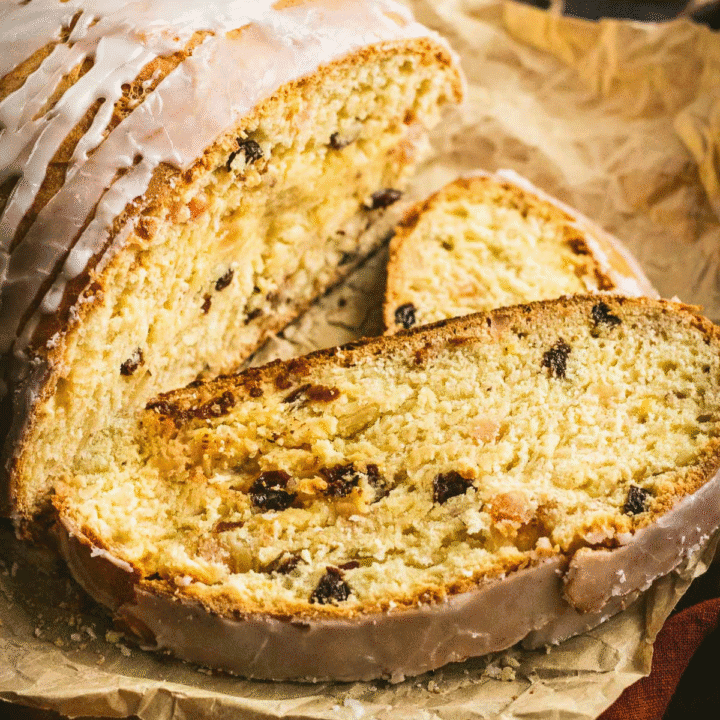
This delicious German Easter bread is made of three braided strands of yeast dough and shaped into a wreath. Packed with raisins, sliced almonds, and warm baking spices, this soft and fluffy loaf is great for spring baking.

Enjoy Spring with Sweet German Easter Bread
I used to love going to the Easter markets in Germany as a kid. I'd collect wreaths and ornaments made of glittery styrofoam eggs. But the best part was always the bread, because German Easter bread is softer and sweeter than other types of popular German bread.
Traditional German Easter bread is called Osterbrot, and it's usually shaped like a round loaf called a boule, while Osterkranz is braided bread shaped like a wreath. And there's also Hefezopf or Osterzopf, which is another braided yeast bread that's shaped like a long loaf.
There are many variations of German Easter bread recipes, and this one is inspired by the loaves we'd see in our neighborhood's Backerei (bakery). The bread is pillowy soft and filled with soaked raisins, so if you enjoy this one, I recommend baking my Rosinenbrotchen next. And if you want to learn how to braid a 4-strand or 5-strand loaf, check out my sweet yeast braided bread with step-by-step photos.

Ingredients, Notes, and Substitutions
- Raisins - You could leave the raisins out, but I think they add essential sweetness. Or swap in candied citron, which is a mix of fruit that I use in my German Stollen.
- Milk - Warm the milk in the microwave for 1 minute or on the stovetop to a lukewarm temperature, between 105°F and 115°F.
- Active dry yeast - One whole packet of yeast helps the bread rise. Make sure your yeast, milk, and sugar mixture gets frothy after 10 minutes, otherwise your yeast may be expired.
- Granulated sugar - Sweetens the dough and helps keep it soft and tender.
- Eggs - Adds a warm color to the bread and a rich flavor. Two eggs are essential to provide a rich flavor. I tried this recipe with just one egg, and it was a little bland.
- Salt - I recommend using non-iodized table salt or fine sea salt (not kosher salt) for the best flavor and distribution within the dough.
- Cinnamon and Nutmeg - Add a warm spiced flavor.
- Orange zest - Feel free to double the amount of orange zest or even add a little orange extract for more punchy citrus flavor.
- Unsalted butter - Softened butter enriches the dough so it's soft and more cake-like.
- All purpose flour - I tried this recipe the first time with cake flour, to see if I can get a softer texture in the bread. However, cake flour doesn't create enough gluten for the bread to hold its shape and rise properly in the oven.
- Almonds - Feel free to use other nuts or leave out the nuts altogether. I think they add a nice crunchy texture. Use sliced or chopped nuts, because large, sharp pieces could tear the dough as you braid it.
- Apricot jam - When brushed on top, apricot jam adds a glossy shine and added sweetness. I didn't add the jam topping in these photos, so your bread will be more shiny if you do add it.
Let's Make this Braided Bread Wreath!


Recipe Testing Notes: Cake Flour versus All Purpose Flour
I initially tried this German Easter bread using cake flour, since it has a lower protein content (7-9%) compared to all purpose flour (which has 9-12% protein).
But the cake flour didn't contain enough gluten for the bread to hold its shape during braiding or to rise properly in the oven. Therefore I definitely recommend using all purpose flour, not cake flour.

German Easter Bread | Osterkranz Braided Wreath
developed & tested by:

Ingredients
- ½ cup raisins
- 1¼ cups milk (warmed in the microwave for 1 minute to a lukewarm temperature)
- 2¼ tsps active dry yeast (one packet)
- ½ cup granulated sugar
- 2 large eggs
- ½ teaspoon salt
- 1 teaspoon ground cinnamon
- ½ teaspoon ground nutmeg
- 2 tablespoon orange zest (from one medium to large orange)
- 6 tablespoon unsalted butter, softened
- 4½ cups all purpose flour (plus extra for kneading)
- ½ cup sliced or chopped almonds
- apricot jam, for brushing on top (optional)
Instructions
- In a small bowl, cover the raisins with an inch of hot water. Set aside so the raisins can soak up the liquid for 30 minutes.
- In another small bowl, mix the warm milk, active dry yeast and granulated sugar. Set aside for about 10 minutes, until it becomes frothy on top.
- In a large mixing bowl, whisk to combine the yeast mixture, eggs, salt, cinnamon, nutmeg, orange zest, and softened butter.
- Add the flour, and mix with a large spoon until there's no visible dry flour, and it forms a very sticky dough.
- Thoroughly drain the raisins and add them to the dough along with the sliced almonds. Knead in the bowl until the raisins and almonds are distributed.
- On a generously floured surface, knead the dough by hand for about 8 minutes, until the dough is mostly smooth and springs back to its original shape when you indent it with your finger. Add a sprinkle of flour as needed to prevent the dough from sticking to the counter as you knead it. Shape the dough into a ball.
- Place the dough back into the same mixing bowl, and cover with a kitchen towel. Let it rest and rise in a warm place (like an empty oven with the light turned on) for about 1 to 2 hours, until it doubles in size.
- Line a baking sheet with parchment paper or a silicone baking mat.
- Once the dough has doubled in size, lightly dust a clean work surface with flour. Divide the dough into three even balls. Gently flatten each one into a rectangle then roll it into a short log to create tension on the surface. Continue rolling the dough between your hands until you have three logs 24-inches in length. Press the tops of the three strands together, then braid them. Press the bottoms of the strands together.
- Braid the Dough: Press the tops of the three strands together. Fold the right strand over the center strand. Fold the left strand over the center strand. Repeat this pattern to the bottom, then pinch the all three strands together.
- Carefully transfer the braid to the prepared baking sheet line, then shape the braid into a circle, and press the ends together. Cover with a kitchen towel and allow to rise for 30 minutes.
- Preheat the oven to 350°F. Bake for 40 to 45 minutes, until the bread is golden.
- Transfer to a cooling rack to cool for at least 20 minutes. Optional: Brush the warm loaf with apricot jam and sprinkle extra sliced almonds on top.
Notes
- Milk: The ideal temperature of the milk should be between 105°F and 115°F.
- Yeast: If the milk, yeast, and sugar don't become frothy after 10 minutes, your yeast might be expired or the milk was too hot or too cold.
- Raisins: It may be tempting to add more raisins in the dough, but when I tried doubling the raisins in a test batch, and it tore the dough while braiding. And for more flavor, you can soak the raisins in apple juice.
- Dough: This dough is sticky at first. Sprinkle half a teaspoon of flour at a time as needed onto the counter to prevent the dough from sticking. And I usually wash my hands after about three minutes, because I find the dough doesn't stick to my hands as much when my hands aren't covered in sticky dough.
- Storing: Store fully cooled bread at room temp for a few days. If it starts to dry out, spread some butter on a slice and microwave it for about 20 seconds.


Bima says
Chunky bread, love it
Carissa Erzen says
Hehe, gotta love fluffy bread!
Rolf says
Very good very good!!
qwweq says
My brother suggested I might like this blog He was totally right This post actually made my day You can not imagine simply how much time I had spent for this info Thanks
Carissa Erzen says
I'm so glad to hear that! Thanks!