

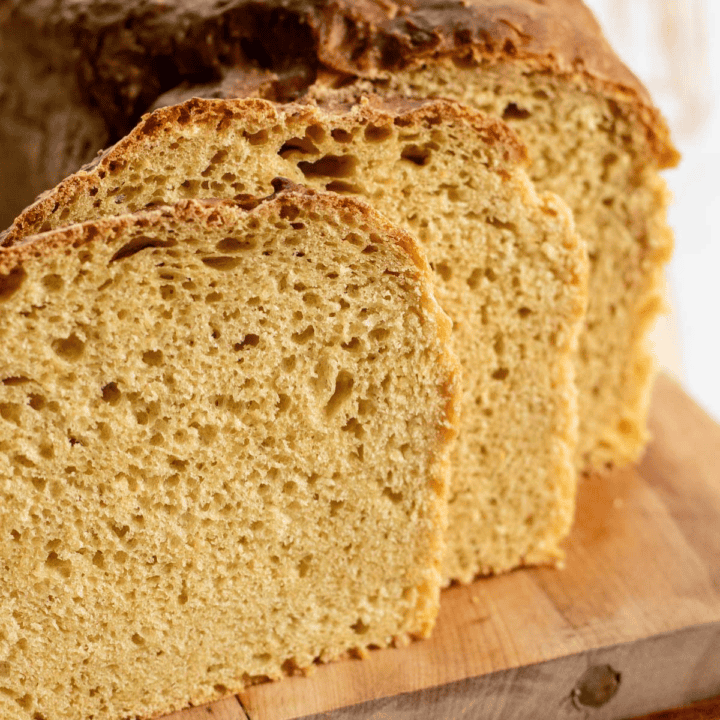
This hearty German rye bread has a soft interior (thanks to soaked rye flour) and a crispy crust that's not too thick, since we're baking it without a Dutch oven. And whole spices are kneaded right into the dough to release their aromatic flavors as the bread is baked.

Authentic Spiced Roggenbrot
Growing up in Germany, I ate traditional German rye bread made with a blend of spices called Brotgewürz, which includes whole caraway seeds, coriander seeds, and fennel seeds. Because the seeds are so small, it doesn't really affect the texture of the bread, and it adds a really unique punch of flavor! I've included the individual spices in this recipe, since a bread spice blend can be difficult to find outside Germany. Or if you prefer your rye bread without spices, check out my no-knead Danish rye bread next.
And while sourdough is often added to German rye bread, I prefer to leave it out of mine, so the dough doesn't become too sticky. As a bonus, this cuts down the total time to get your loaf hot + fresh out of the oven!

The Art of Baking with Rye Flour
My biggest tip after baking dozens and dozens of homemade rye bread loaves is to hydrate your rye flour. That's why I mix the rye flour with water and let it sit for 20 minutes before adding the rest of the dry ingredients.
And while traditional Roggenbrot is made with 100% rye flour, I found that adding some all purpose flour to the dough makes it way less sticky and much easier to knead. When I exclusively use rye flour in bread dough like my German brown bread, it's much wetter and not elastic, so it needs to be baked in a loaf pan. I also add a little whole wheat flour to help strengthen the structure of the bread.
Finally, I recommend using medium or dark rye flour here. It'll add a wonderful flavor and color, but it won't be too heavy. Same goes for my chocolate chip rye cookies, which should be on your list next!

Ingredients and Notes
- Rye flour - Rye flour is essential in German rye bread. It gives the bread its characteristic tangy, earthy flavor, dark color, and chewy texture.
- Instant yeast - Instant yeast (unlike active dry yeast) does not need to be activated before you can use it. Instant yeast also requires less time to proof, which means you can enjoy your bread sooner!
- Molasses - Adds moisture, a rich caramel-like flavor, and deepens the color of the bread. I've tested this with honey, and the bread was lighter and sweeter.
- Lukewarm water - Try to use water between 95°F to 105°F. The warm water will enhance the activity of the yeast. Water that's cold will slow down the yeast, and water that's too hot could kill the yeast.
- All purpose flour
- Whole wheat flour - Helps the bread rise and create a strong structure.
- Salt - Salt not only adds flavor, but it also strengthens the structure of the dough, which is important in rye bread.
- Seeds
Let's Bake a Loaf of Rustic Rye Bread!

1. Mix together the rye flour, yeast, molasses, and water until it forms a really wet, loose mixture. Set aside for 20 minutes.

3. Knead the dough until it becomes smooth and elastic.

5. Cover it with a clean kitchen towel and let rise until it about doubles in size, after about 1 hour.

7. Cover the dough with a towel & proof for 1 hour, until it puffs up. It may or may not fully double in size.

2. Add the all purpose flour, whole wheat flour, salt, and optional seeds. Mix the dough for a few minutes until it forms a wet dough.

4. Place the kneaded dough ball into the oiled mixing bowl.

6. On a lightly floured surface, shape the dough into a round or oval shape & create tension on top.

8. Bake for 30 to 35 minutes, until the loaf has a crispy crust and sounds hollow when tapped on the bottom.
Rye Bread Rolls
I love using this same recipe to make small rye bread rolls (called Roggenbrotchen) by shaping them into small rounds after the first rise & baking them for 18 to 22 minutes.
My Tips on Handling Bread Dough
- Rising: When rising dough, I usually place it in the oven (turned off) with the oven light on. This creates a draft-free environment. And the small amount of heat from the oven light will help encourage the yeast's activity.
- Kneading: When I'm kneading the dough, I pour about ½ cup of all purpose flour in a small bowl to keep close by. This allows me to add sprinkles of flour without putting my dough-covered hand in the flour bag.
- Avoid Gummy Bread: When baked bread is pulled out of the oven, the inside still bakes for a little while, so I always let mine cool on a cooling rack for at least 30 minutes (even better if it's a full hour) before slicing it.


German Rye Bread | Roggenbrot
developed & tested by:

Equipment
Ingredients
- 1¾ cups medium or dark rye flour
- 2¼ teaspoons instant yeast (one packet)
- 2 Tablespoons molasses
- 1¾ cups lukewarm water
- 2 cups all purpose flour
- ⅓ cup whole wheat flour
- ½ teaspoon salt (use table salt or fine sea salt)
- 1½ teaspoon caraway seeds (optional)
- ½ teaspoon coriander seeds (optional)
- ½ teaspoon fennel seeds (optional)
Instructions
- In a large mixing bowl, mix together the rye flour, yeast, molasses, and water until it forms a really wet, loose mixture, and there are no visible pockets of dry flour. Set aside for 20 minutes, to allow the rye flour to absorb some of the liquid.
- Add the all purpose flour, whole wheat flour, salt, and optional seeds to the rye flour mixture and mix the dough in the mixing bowl for a few minutes, until it forms a wet dough, and there are no visible pockets of dry flour.
- On a generously floured work surface, knead the dough for another 5 to 10 minutes, until the dough is a smooth ball. Add a sprinkle of about a teaspoon of all purpose flour or rye flour periodically as you knead the dough, if it is still really sticky.
- Lightly oil a clean mixing bowl with olive oil. Place the kneaded dough ball into the oiled mixing bowl. Cover it with a clean kitchen towel and let rise until it about doubles in size, after about 1 hour.
- On a lightly floured work surface, tip out the dough and shape it into a round or oval shape. Gently spread the top edges of the dough down the sides and underneath, to create tension on the top. All the seams or edges of the dough should be tucked underneath.
- Place the dough on a baking sheet lined with parchment paper or a silicone baking mat. Very lightly dust the top with a little flour, just so the towel doesn't stick to it. Cover the dough again with a towel and allow to proof for another 1 hour in a warm draft-free spot. The dough is done proofing once it's puffed up in size (it likely won't double in size, but it'll be a little larger).
- Preheat the oven to 400°F. Bake for 30 to 35 minutes, until the loaf has a crispy crust and sounds hollow when tapped on the bottom. Allow the loaf to cool on a cooling rack for at least 30 minutes before slicing. Enjoy!!
Notes
- Scoring: There's no need to cut slashes into the top of the loaf to score it, since we're baking it without steam or a Dutch oven.
- Proofing: To check if your dough is done proofing (after shaping it) you can press your finger into the top of the dough about ½ inch deep. If the indent from your finger slowly springs back to its original shape, it's done proofing. If the indent springs back right away, proof it for another 10 minutes and check it again.
- Storing: Store your German rye bread in a paper bag or clean kitchen towel at room temperature for up to a few days.



Deb says
I'm wondering about whether the dough should be punched down between proofs. All the other recipes I've looked at include punching it down.
Carissa Erzen says
Hi Deb, no need to punch down the dough for my version! Let me know if you get a chance to bake it, I'd love to know how it turns out for you.
Susan Reynolds says
This is a fabulous recipe!!! Flavour and texture is so lovely. So very easy to make!! Definitely on my favourite list. Thank you!!
Carissa Erzen says
Hi Susan, I'm so glad to hear that you enjoyed this bread, thank you so much! This is one of my favorites too, gotta love a no-knead bread!
Leonard Caponegro says
I love the easy to follow instructions. The Roggenbrot came out perfect. So delicious it can be eaten plain or with meats and cheese.
Carissa Erzen says
Hi Leonard, I'm so glad to hear you enjoyed this loaf! And same, I love it the same plain or as a sandwich.
Rolf says
Traditional, very good!
Carissa Erzen says
I'm so glad you enjoyed this bread, Rolf!