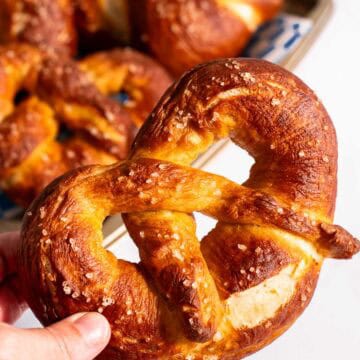
Easy German Pretzels (Without Lye)
developed & tested by:

Made with melted butter and a little brown sugar, these German pretzels stay soft for days. And while they’re shaped and scored like Bavarian Brezeln, a simple baking soda bath replaces the traditional lye solution to keep things simple.
Equipment
Ingredients
Dough
- 4 cups all purpose flour
- 2¼ teaspoons instant yeast
- 1 Tablespoon dark brown sugar
- 2 teaspoons salt (use table salt or fine sea salt)
- 1¼ cups warm water (between 105-115°F or 40-46°C)
- 4 Tablespoons unsalted butter, melted
Baking Soda Bath
- 10 cups water
- ½ cup baking soda
Topping
- 2 teaspoons pretzel salt
Instructions
Mix the Dough & Let it Rise
- In a large bowl, mix the flour, instant yeast, brown sugar, and salt together.
- Add the warm water and melted butter to the flour mixture. Knead the mixture in the bowl until it forms a shaggy dough.
- Lightly flour a clean work surface. Knead the dough on the work surface until it forms a smooth dough, after about 8 by hand, or about 5-6 minutes in a stand mixer with a dough hook attachment. Form the dough into a ball.
- Lightly oil a clean mixing bowl with a little olive oil or butter. Place the dough ball in the oiled bowl and cover with a damp dishcloth or dinner plate until the dough doubles in size, after about 2 hours.
The dough will feel dry at first, but the more you knead it, the more the flour will hydrate. It may even end up feeling a little tacky towards the end, but resist the urge to add more flour. Instead, if the dough is sticking to your hands, wet them with cold water to finish kneading & shaping the dough.
Shape the Pretzels
- Preheat the oven to 425°F. Generously grease a baking sheet or line it with a silicone baking mat. (Don't use parchment paper, which will stick to the pretzels.)
- Bring 10 cups of water and the baking soda to a boil on the stove on high heat.
- On a clean work surface, divide the dough into 8 equal portions. Keep the dough covered with a kitchen towel as you shape the pretzels, so it doesn't dry out.
- Roll one portion of dough on your counter to about 24 inches in length, using even pressure between your hands.
- Hold the two ends in each hand, and form a large U-shape with the dough log. Cross the two ends and bring them down towards the curve of the U-shape. Let about an inch of dough hang over the edge of the U-shape. Gently press the two ends into the dough, about 3-inches (8cm) apart. Repeat shaping the remaining dough, arranging them on your prepared baking sheet as you go.
For Bavarian pretzels, roll the ends much thinner, while keeping the middle thick.
Boil and Bake the Pretzels
- Gently lower the first two pretzels into the boiling baking soda and water. Boil for 30 seconds, then turn them over and boil on the second side for another 30 seconds. Use a slotted spoon to remove the pretzels from the pot, gently tapping the spoon on the pot a couple times to get rid of extra water on the dough, then place them back on your prepared baking sheet. Repeat with the remaining pretzels, boiling batches of two at a time.
- While the pretzels are still wet, sprinkle the pretzel salt evenly on top.
- Bake for 12-15 minutes, until the pretzels are deep brown.
For Bavarian-style pretzels, score a single slash along the "belly" or thick bottom curve, about 1-inch (2.5cm).
Notes
- Pretzel Salt: The best salt to use for pretzels is coarse salt or pretzel salt. This salt is thicker than kosher salt, and it won't melt in the oven or dissolve on the surface of the pretzels. If you can't find coarse salt, you can use kosher salt in a pinch, but the salt granules will dissolve on leftover pretzels after about a day.
- Forming Your Pretzels: Make sure the ends of your twisted pretzel are pressed down firmly into the belly of the pretzel. Otherwise, it could unravel in the boiling water. If it's not sticking, add a little water to help stick the pretzel together.
- Topping: Immediately sprinkle coarse salt on the pretzels once they're done boiling. The salt will stick while they're still wet, but it'll just slide right off if they dry out.
- Storing: These homemade pretzels taste best when they're fresh, on the same day they're baked. Store fully cooled pretzels at room temperature in a paper bag or wrapped in a kitchen towel for up to 3 days, since an airtight container will make the salt dissolve into the crust.
Nutrition
Serving: 1 pretzel (of 8)Calories: 294kcalCarbohydrates: 51gProtein: 8gFat: 7gSaturated Fat: 4gPolyunsaturated Fat: 0.5gMonounsaturated Fat: 2gTrans Fat: 0.2gCholesterol: 15mgSodium: 3236mgPotassium: 103mgFiber: 3gSugar: 2gVitamin A: 176IUVitamin C: 0.01mgCalcium: 24mgIron: 3mg
Did you make this recipe?Leave a comment below - I love hearing from you!