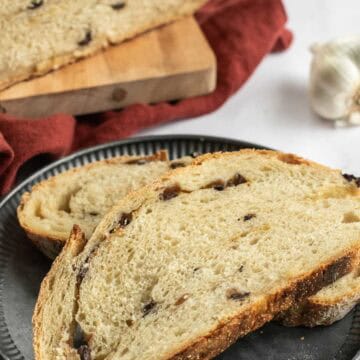
Roasted Garlic and Olive Bread
developed & tested by:

This Dutch oven olive bread has a crispy crust, soft crumb, and pockets of savory in every bite from roasted garlic paste and chopped kalamata olives folded into the dough.
Equipment
Ingredients
Roasted Garlic Paste
- 1 head of garlic
- 1 Tablespoon plus 2 teaspoons olive oil, divided
- ⅛ teaspoon kosher salt
- ⅛ teaspoon black pepper
Olive Bread
- 4½ cups all purpose flour
- 2¼ teaspoons active dry yeast (one packet)
- 1½ teaspoons salt (use table salt or fine sea salt)
- 2 teaspoons onion powder
- 1½ cups warm water (between 105°F and 110°F)
- ⅓ cup kalamata olives, roughly chopped
Instructions
Make the Garlic Paste
- Preheat the oven to 400°F (205°C). Cut the top ½-inch (1.25 cm) off the head of garlic, to expose the cloves inside. Remove any of the loose papery skin, but leave the whole bulb intact.
- Place the head of garlic cut-side-up on a large piece of aluminum foil. Drizzle 2 teaspoons (9 g) of the olive oil on top slowly, allowing it to seep down in between the cloves. Sprinkle with ⅛ teaspoon (a pinch) of salt and black pepper.
- Wrap the garlic tightly in the aluminum foil and place on a baking sheet. Bake for 40 to 50 minutes, until the garlic cloves are soft and golden brown.
- Cool for a few minutes, then squeeze the bottom of the garlic bulb so the cloves pop out into a mixing bowl. Add the remaining 1 tablespoon (14 g) of olive oil and mash it with a fork until it forms a thick paste. Set aside.
Make the Bread Dough
- In a mixing bowl, whisk the flour, active dry yeast, salt, and onion powder.
- Add the warm water and mix until it forms a shaggy (somewhat stiff) dough.
- On a lightly floured surface, knead the dough for 5-7 minutes by hand or 4-5 minutes in a stand mixer with a dough hook attachment.
- Shape the dough into a ball and place it back in the mixing bowl. Cover with a clean kitchen towel or dinner plate and let it rise in a warm, draft-free spot until it doubles in size, after about 1.5 to 2 hours.
Fill, Shape, & Bake
- Prep the olives: Pat the olives dry with paper towels, and toss them in a bowl with one teaspoon of flour. (This prevents them from sinking or creating wet pockets.)
- On a lightly floured surface, spread out the dough into a rectangle, about ½-inch (1.25 cm) thick. Gently spread out half of the cooled roasted garlic paste and half of the flour-coated olives on top.
- Fold the bread in thirds, like a letter so it forms a smaller rectangle. Gently press it out to about ½-inch (1.25 cm) thick again. Spread the remaining half of the garlic paste and olives on top. Fold it in thirds like a letter again. (This will distribute the garlic & olives more evenly).
- Gently shape the bread into a ball and create tension by gently pushing the top of the dough from the center, down the sides, and underneath. Try not to tear the dough, to avoid any olives being exposed on the surface.
- Place the dough seam-side-up in a proofing basket or shallow bowl lined with a kitchen towel & dusted with a little flour. Cover with a towel & allow it to proof for 30 minutes, or until an indentation made by your finger into the dough springs back after 2-3 seconds.
- While the dough proofs, place a Dutch oven with the lid on the bottom rack of your oven and preheat it to 450°F (230°C).
- Transfer the proofed loaf seam-side-down onto a large piece of parchment paper sprinkled with a little flour or cornmeal. Remove the hot Dutch oven from the preheated oven and carefully transfer the dough by the corners of the parchment paper into the Dutch oven. Bake with the lid on for 30 minutes, then remove the lid and bake for another 10-15 minutes, until the crust is golden and crispy. Allow the bread to cool on a cooling rack for at least 1 hour before slicing.
Notes
- Olives: You can swap in green Castelvetrano olives for a sweeter, buttery flavor or Niçoise olives for an even richer flavor. Just don't use black olives, which are too bland in this bread.
- Storing: Allow your loaf to cool completely before storing in a paper bag or wrapped in a linen towel.
Nutrition
Serving: 1 slice (of 12)Calories: 193kcalCarbohydrates: 37gProtein: 5gFat: 2gSaturated Fat: 0.3gPolyunsaturated Fat: 0.4gMonounsaturated Fat: 1gSodium: 377mgPotassium: 70mgFiber: 2gSugar: 0.2gVitamin A: 16IUVitamin C: 1mgCalcium: 16mgIron: 2mg
Did you make this recipe?Leave a comment below - I love hearing from you!